1. Mawu Oyamba
Thank you for choosing the KAIWEETS KC200D Digital Clamp Meter. This device is a compact, high-precision instrument designed for electrical measurements in various settings, including home, commercial, and industrial environments. It features True RMS technology for accurate readings of complex waveforms, Non-Contact Voltage (NCV) detection for enhanced safety, and a clear backlit LCD for easy readability. This manual provides essential information for safe and effective use of your clamp mita.
2. Zambiri Zachitetezo
To ensure safe operation, please read and understand all safety warnings and operating instructions before using this instrument. Failure to observe these warnings can result in serious injury or death.
- Nthawi zonse tsatirani malamulo a chitetezo chapafupi ndi dziko.
- Do not use the meter if it appears damaged or if the insulation on the test leads is compromised.
- Osagwiritsa ntchito kuposa voliyumu yovoteratage, as marked on the meter, between terminals or between any terminal and ground. The maximum operating voltagndi 600v.
- Gwiritsani ntchito mosamala kwambiri mukamagwira ntchito ndi voltages above 60V DC or 30V AC RMS. These voltagndi chiwopsezo chowopsa.
- Keep your fingers behind the finger guards on the test leads during use.
- Osagwiritsa ntchito mita pamalo ophulika, mpweya, kapena fumbi.
- Remove the test leads from the circuit before changing functions.
- Always turn off the power to the circuit under test before connecting or disconnecting the test leads.
- Ensure the battery cover is securely closed before operating the meter.
3. Zamkatimu Phukusi
Verify that all items listed below are present and undamaged:
- 1 x KAIWEETS KC200D Digital Clamp Mita
- 1 x Buku Logwiritsa Ntchito
- 1 x Chikwama Chosungira
- Mayeso Otsogolera Awiri (Ofiira ndi Akuda)
- 2 x AAA 1.5V Mabatire
4. Zamalonda Zathaview
The KAIWEETS KC200D is designed for ease of use and durability. Familiarize yourself with the main components:
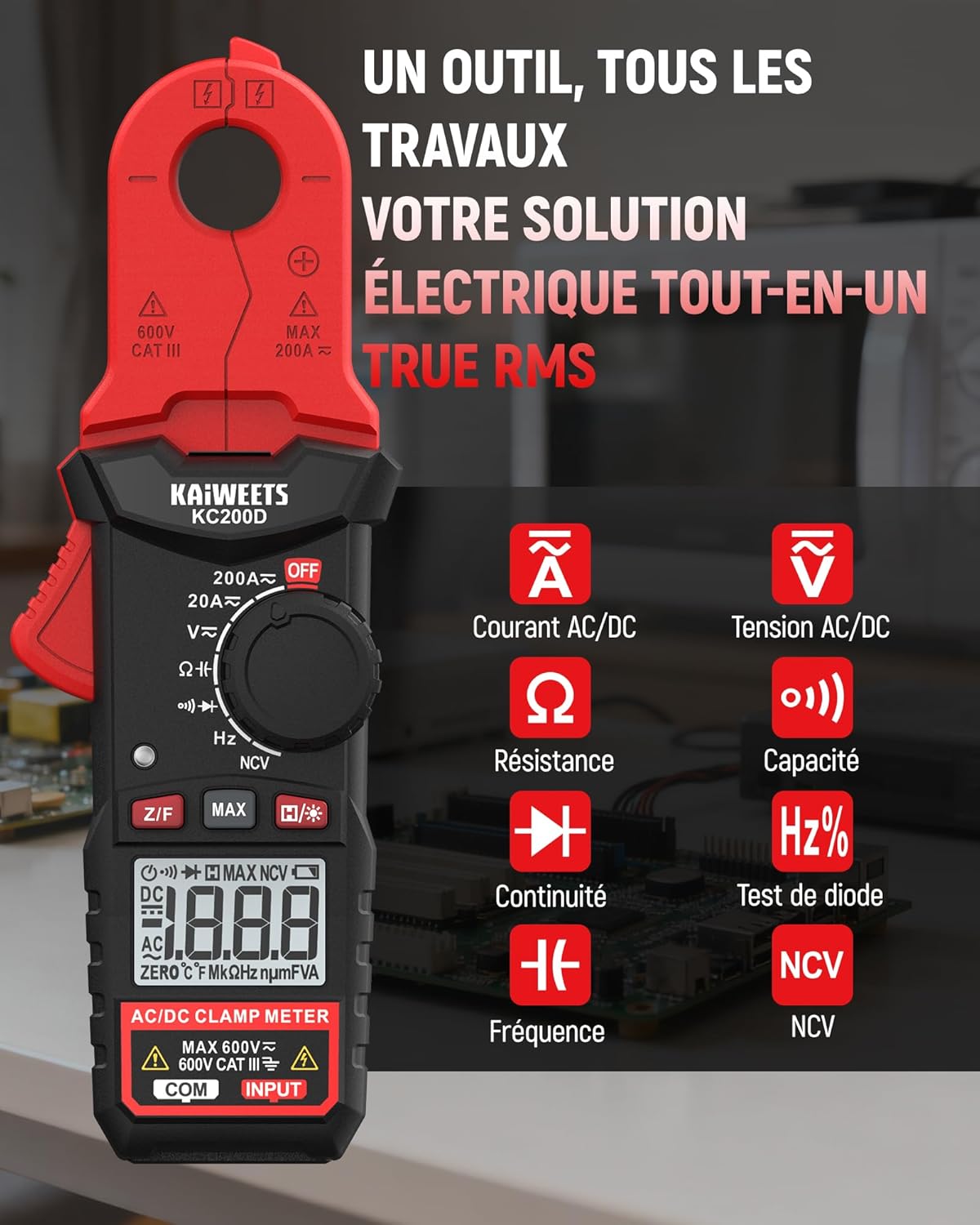
Chithunzi 4.1: KAIWEETS KC200D Clamp Meter with its various measurement functions highlighted, including AC/DC Current, AC/DC Voltage, Resistance, Capacitance, Frequency, Diode Test, Continuity, and NCV.
4.1 Zigawo Zofunikira
- Clamp Chibwano: Used for non-contact AC/DC current measurement.
- Kuyimba ntchito: Rotary switch to select measurement modes.
- Chiwonetsero cha LCD: Imasonyeza ziwerengero za muyeso, mayunitsi, ndi zizindikiro.
- Mabatani: For special functions like Data Hold, MAX/MIN, DC Zero, Backlight, and NCV.
- Malo Olowera: For connecting test leads for voltage, resistance, capacitance, frequency, diode, and continuity measurements.
5. Kukhazikitsa
5.1 Kuyika kwa Battery
The KC200D requires two AAA 1.5V batteries (included).
- Onetsetsani kuti mita yazimitsidwa.
- Pezani batire kumbuyo kwa mita.
- Gwiritsani ntchito sikukuruvayira kuti mutsegule chivundikiro cha chipinda cha batri.
- Insert the two AAA batteries, observing the correct polarity (+ and -).
- Bwezerani chivundikiro cha chipinda cha batri ndikuchiteteza ndi screw.
5.2 Kulumikiza Zotsogolera Zoyesa
For measurements requiring test leads (voltage, resistance, capacitance, frequency, diode, continuity):
- Insert the red test lead into the "INPUT" terminal.
- Insert the black test lead into the "COM" (Common) terminal.
6. Malangizo Ogwiritsira Ntchito
Always select the appropriate function before making any measurement. Turn the function dial to the desired measurement mode.
6.1 Muyeso wa AC/DC wamakono (Cl)amp)
Gwiritsani ntchito clamp jaw for non-contact current measurement. This method is ideal for safely measuring current without breaking the circuit.

Chithunzi 6.1: Clamp jaw of the KC200D measuring current on a single electrical wire, demonstrating its compact design and precision.
- Sinthani kuyimba kwa ntchito ku 20A ~ or 200A ~ position for AC current, or 20A = or 200A = for DC current.
- Dinani pa clamp trigger to open the jaw.
- Encircle only imodzi conductor with the clamp jaw. Do not clamp around multiple wires, as this will result in an inaccurate reading.
- For DC current measurement, press the Z/F button to zero the display before clampndi.
- Werengani mtengo wapano pa chiwonetsero cha LCD.
6.2 AC/DC Voltagndi Kuyeza
Kuyeza voltage, use the test leads.
- Sinthani kuyimba kwa ntchito ku V~ (AC Voltage) kapena V= (DC Voltage) udindo.
- Connect the red test lead to the positive side of the circuit and the black test lead to the negative side (or ground).
- Werengani voltagndi mtengo pachiwonetsero cha LCD.
6.3 Muyeso wa Resistance
Onetsetsani kuti dera latha mphamvu musanayese kukana.
- Sinthani kuyimba kwa ntchito ku Ω udindo.
- Gwirizanitsani zoyeserera pagawo lililonse kuti muyese.
- Werengani mtengo wotsutsa pachiwonetsero cha LCD.
Kuyeza kwa Capacitance
Discharge capacitors completely before measurement to avoid damage to the meter or injury.
- Sinthani kuyimba kwa ntchito ku Kuthekera position (often shared with Diode/Continuity, press FUNC to cycle).
- Lumikizani ma lead oyesera kudutsa pa capacitor.
- Werengani mtengo wa capacitance pachiwonetsero cha LCD.
6.5 Kuyeza pafupipafupi
Kuyeza pafupipafupi:
- Sinthani kuyimba kwa ntchito ku Hz% udindo.
- Connect the test leads across the circuit where frequency is to be measured.
- Werengani kuchuluka kwafupipafupi pachiwonetsero cha LCD.
Mayeso a 6.6 Diode
Onetsetsani kuti diode yachotsedwa pa dera.
- Sinthani kuyimba kwa ntchito ku Diode position (often shared with Capacitance/Continuity, press FUNC to cycle).
- Connect the red test lead to the anode and the black test lead to the cathode.
- A forward voltage drop will be displayed for a good diode. Reverse the leads; the display should show OL (Open Loop).
6.7 Kupitiliza Kuyesa
Onetsetsani kuti derali ndi lopanda mphamvu.
- Sinthani kuyimba kwa ntchito ku Kupitiliza position (often shared with Diode/Capacitance, press FUNC to cycle).
- Connect the test leads across the component or wire.
- If there is continuity (low resistance), the meter will emit an audible beep.
6.8 Osalumikizana Voltage (NCV) Kuzindikira
The NCV function allows for quick and safe detection of live AC voltage popanda kukhudzana mwachindunji.

Chithunzi 6.2: The KC200D performing Non-Contact Voltage (NCV) detection near an electrical outlet, showing visual indicators for low and high voltagndi kupezeka.
- Sinthani kuyimba kwa ntchito ku NCV udindo.
- Bring the top end of the meter near the conductor or outlet.
- The meter will emit an audible beep and illuminate LED indicators, with frequency increasing as voltage strength increases.
6.9 Ntchito Zapadera

Chithunzi 6.3: The KC200D highlighting its user-friendly functions: MAX for peak value, Z/F for DC current zeroing, H for data hold, backlight for low-light conditions, and auto-off for battery saving.
- Data Hold (H/* button): Dinani kuti muyimitse kuwerenga kwamakono pa chiwonetserocho. Dinani kachiwiri kuti mutulutse.
- MAX/MIN (MAX button): Press to display the maximum or minimum measured value. Press again to cycle.
- DC Current Zero (Z/F button): For DC current measurements, press this button before clamping to zero out any residual readings.
- Backlight (H/* long press): Long press the H/* button to turn the display backlight ON or OFF for improved visibility in low-light conditions.
- Zozimitsa zokha: The meter automatically powers off after approximately 15 minutes of inactivity to conserve battery life. Press any button or rotate the function dial to wake it up.
7. Kusamalira
7.1 Kuyeretsa
Pukutani choyezera ndi nsalu youma komanso yofewa. Musagwiritse ntchito zinthu zopukutira kapena zosungunulira.
7.2 Kusintha kwa Battery
When the battery indicator appears on the LCD, replace the batteries as described in the Setup section (5.1 Battery Installation).
7.3 Kusungirako
If the meter is not used for an extended period, remove the batteries to prevent leakage and damage. Store the meter in its carrying bag in a cool, dry place.
8. Mavuto
| Vuto | Chifukwa Chotheka | Yankho |
|---|---|---|
| Chida sichikugwira ntchito | Dead batteries; Incorrect battery installation | Sinthani mabatire; Onani polarity ya batri |
| Inaccurate current reading | Multiple conductors in clamp jaw; DC current not zeroed | Ensure only one conductor is clamped; Press Z/F button for DC current |
| "OL" displayed (Overload) | Measurement exceeds range; Open circuit (for continuity/resistance) | Select a higher range (if available); Check circuit connections |
| Palibe kupezeka kwa NCV | Palibe AC voltage present; Meter not close enough to source | Tsimikizani AC voltage presence; Move meter closer to the live conductor |
9. Zofotokozera
Technical specifications for the KAIWEETS KC200D Digital Clamp mita:
| Mbali | Kufotokozera |
|---|---|
| Nambala ya Model | Chithunzi cha KC200D |
| Onetsani | 2000 Counts, Backlit LCD |
| AC Zamakono | 20A/200A (±(2.5% + 5 digits)) |
| DC Tsopano | 20A/200A (±(2.5% + 5 digits)) |
| AC Voltage | 2V/20V/200V/600V (±(1.0% + 5 digits)) |
| DC Voltage | 200mV/2V/20V/200V/600V (±(0.5% + 5 digits)) |
| Kukaniza | 200Ω/2kΩ/20kΩ/200kΩ/2MΩ/20MΩ (±(1.0% + 5 digits)) |
| Kuthekera | 2nF/20nF/200nF/2µF/20µF/200µF/2mF/20mF (±(4.0% + 5 digits)) |
| pafupipafupi | 2Hz/20Hz/200Hz/2kHz/20kHz/200kHz/2MHz/20MHz (±(1.0% + 3 digits)) |
| Mayeso a Diode | Inde |
| Kupitiliza Mayeso | Inde |
| Kuzindikira kwa NCV | Inde |
| Magetsi | 2 x AAA 1.5V Mabatire |
| Mayeso a Chitetezo | CAT III 600V, Pollution Level: 2 |
| Makulidwe | 20.7 x 11.3 x 4.7 cm (Phukusi) |
| Kulemera | 308 grams (Package) |
10. Chitsimikizo ndi Thandizo
KAIWEETS products are designed for reliability and performance. For warranty information, technical support, or service inquiries, please refer to the contact information provided on the KAIWEETS official website or contact your local distributor. Please retain your purchase receipt as proof of purchase for warranty claims.


