1. Mawu Oyamba
This manual provides essential information for the safe and efficient installation, operation, and maintenance of the VEICHI AC10 series frequency converters. Please read this manual thoroughly before using the product to ensure proper handling and to prevent damage or injury.
The VEICHI AC10 series frequency converters are designed for general-purpose applications, offering reliable motor control and energy efficiency. This manual covers models such as AC10-T/S2-R75G-B-220V, AC10-T/S2-1R5G-B-220V, AC10-T/S2-2R2G-B-220V, AC10-T3-R75G-B-380V, and AC10-T3-1R5G-B-380V.
2. Chitetezo
Always observe the following safety precautions to prevent electric shock, fire, or personal injury. Failure to comply may result in severe consequences.
- Oyenerera: Installation, wiring, operation, and maintenance must be performed by qualified electrical personnel only.
- Kuyimitsa Mphamvu: Always disconnect all power sources before performing any wiring or maintenance. Wait at least 5 minutes after power off for the capacitor discharge indicator to extinguish.
- Kuyika pansi: Ensure the frequency converter is properly grounded according to local electrical codes.
- Zachilengedwe: Do not operate the converter in environments exceeding specified temperature, humidity, or dust levels.
- Zophimba Zoteteza: Do not remove protective covers or touch internal components while power is applied.
3. Zamalonda Zathaview
The VEICHI AC10 series frequency converter features a compact design with an integrated control panel for easy operation and monitoring.
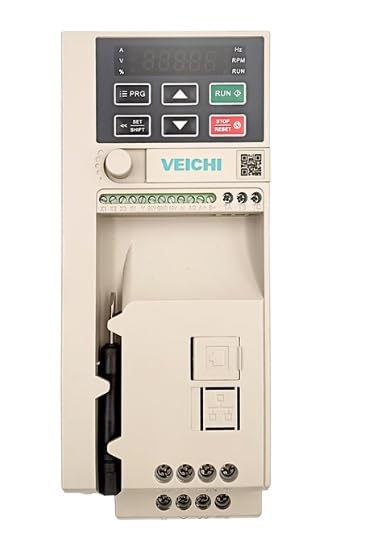
Chithunzi 3.1: Patsogolo view of the VEICHI AC10 Frequency Converter. This image displays the main unit, highlighting the digital display for parameters, control buttons for programming and operation, and the various terminal blocks for power and control wiring. A screwdriver is visible in the side compartment.
3.1. Control Panel Layout
The control panel consists of a digital display and several function buttons:
- Onetsani: Shows operational parameters, fault codes, and programming values.
- PRG (Pulogalamu): Lowetsani/kutuluka munjira yokhazikitsira magawo.
- Mivi Yam'mwamba/Pansi: Navigate through parameters, adjust values.
- THAMANI: Zimayambira motere.
- IMANI/BWERETSA: Stops the motor, resets fault conditions.
- SET/SHIFT: Confirms parameter settings, shifts cursor during input.
4. Kukhazikitsa ndi Kuyika
4.1. Kukwera
Mount the frequency converter vertically on a flat, non-flammable surface. Ensure adequate ventilation space around the unit (at least 10 cm above and below, 5 cm on sides) for heat dissipation.
4.2. Kulumikizana
Refer to the wiring diagram provided with your specific model for detailed connections. General wiring guidelines:
- Kulowetsa Mphamvu (R, S, T kapena L1, L2): Connect to the main power supply. Ensure correct voltage (220V or 380V depending on model).
- Kutulutsa kwa Magalimoto (U, V, W): Lumikizani ku ma terminals amagalimoto.
- Pansi (PE): Lumikizani ku malo odalirika.
- Control Terminals: For external control signals (e.g., start/stop, speed reference, fault output).
Warning: Incorrect wiring can lead to severe damage to the unit or personal injury. Consult a qualified electrician if unsure.
5. Malangizo Ogwiritsira Ntchito
5.1. Mphamvu-Mmwamba Yoyamba
- After completing all wiring, apply power to the frequency converter.
- The display will light up, typically showing "0.00" or a default frequency.
5.2. Basic Operation (Keypad Control)
- Khazikitsani pafupipafupi: Dinani pa PRG button to enter parameter mode. Navigate to the frequency setting parameter (e.g., F0.01) using the MUP/PASI mivi. Press SET/SHIFT to edit, adjust value, then SET/SHIFT again to confirm. Press PRG kutuluka.
- Yambani Motor: Dinani pa Thamangani batani. Motor idzafulumizitsa kufupipafupi komwe kumayikidwa.
- Imani Njinga: Dinani pa Lekani / Bwezeretsani batani. Motor idzatsika ndikuyima.
5.3. Makonda a Parameter
The AC10 series has a comprehensive set of parameters for various functions. Refer to the detailed parameter list in the full product manual for advanced configurations (e.g., acceleration/deceleration times, motor parameters, control modes).
Exampndi parameters:
- F0.00: Run command source (keypad, terminal, communication)
- F0.01: Frequency setting source (keypad, analog input, communication)
- F0.03: Max linanena bungwe pafupipafupi
- F0.04: Nthawi yofulumira
- F0.05: Deceleration nthawi
6. Kusamalira
Regular maintenance ensures the longevity and reliable operation of your frequency converter.
- Kuyeretsa: Periodically clean the cooling fins and fan to prevent dust accumulation, which can hinder heat dissipation. Use compressed air or a soft brush. Ensure power is off before cleaning.
- Kuwona Pokwerera: Annually check all wiring terminals for tightness. Loose connections can cause overheating or intermittent operation.
- Kuwona Zachilengedwe: Onetsetsani kuti malo ogwirira ntchito ali mkati mwa kutentha ndi chinyezi chomwe chatchulidwa.
- Fan Replacement: Cooling fans have a limited lifespan. Consider replacing them every 3-5 years, depending on operating conditions, to maintain optimal cooling.
7. Mavuto
This section provides common issues and their potential solutions. For complex problems, contact technical support.
| Problem/Fault Code | Chifukwa Chotheka | Yankho |
|---|---|---|
| No Display/Power | No input power; Blown fuse; Internal fault. | Check power supply; Check fuses; Contact support. |
| Overcurrent (OC) Fault | Motor overload; Short circuit in motor wiring; Rapid acceleration/deceleration. | Check motor load; Inspect motor wiring; Increase acceleration/deceleration time. |
| Kupambanatage (OV) Fault | Lowetsani voltage too high; Rapid deceleration with high inertia load. | Onani voltage; Increase deceleration time; Consider braking resistor. |
| Kusamalatage (UV) Fault | Lowetsani voltage too low; Power supply dip. | Onani voltage; Ensure stable power supply. |
| Overheat (OH) Fault | Ambient temperature too high; Fan failure; Blocked ventilation. | Improve ventilation; Clean cooling fins; Check fan operation. |
To reset a fault, press the Lekani / Bwezeretsani button after resolving the cause.
8. Zofotokozera
The following specifications are typical for the VEICHI AC10 series. Specific values may vary slightly by model.
| Parameter | Mtengo/Mtundu |
|---|---|
| Lowetsani Voltage | Single-phase 220V (AC10-T/S2 models) or Three-phase 380V (AC10-T3 models) |
| Linanena bungwe Zosiyanasiyana | 0.00 Hz - 400.00 Hz |
| Control Mode | V/F control, Sensorless vector control |
| Kuchuluka Kwambiri | 150% of rated current for 60 seconds |
| Mawonekedwe a Chitetezo | Overcurrent, Overvoltage, Undervoltage, Overheat, Overload, Short circuit |
| Kutentha kwa Ntchito | -10°C mpaka 40°C (14°F mpaka 104°F) |
| Chinyezi | Pansi pa 90% RH (yosasunthika) |
| Makulidwe (Approx.) | Varies by power rating (e.g., 2 x 2 x 2 inches for smaller models) |
| Kulemera kwake (pafupifupi.) | Varies by power rating (e.g., 4.41 Pounds for smaller models) |
Note: For precise specifications of your specific model, refer to the product label or the comprehensive technical datasheet.
9. Chitsimikizo ndi Thandizo
9.1. Chidziwitso cha Chitsimikizo
This product is typically covered by a manufacturer's warranty against defects in materials and workmanship for a period specified at the time of purchase. Please retain your proof of purchase for warranty claims. The warranty does not cover damage caused by improper installation, misuse, unauthorized modification, or operation outside of specified environmental conditions.
For specific warranty terms and conditions, please refer to the documentation provided with your purchase or contact the seller.
9.2. Thandizo laukadaulo
If you encounter issues that cannot be resolved using the troubleshooting guide, or require further technical assistance, please contact your supplier or the manufacturer's authorized service center.
When contacting support, please be prepared to provide the following information:
- Product Model Number (e.g., AC10-T/S2-1R5G-B-220V)
- Serial Number (if applicable)
- Tsiku Logula
- Detailed description of the problem, including any fault codes displayed.