1. Mawu Oyamba
This manual provides instructions for the safe and effective use of the Sealey MM19 Digital Multimeter. The MM19 is a general-purpose multimeter designed for measuring various electrical parameters, including AC and DC voltage, DC current, resistance, audible continuity, and diode/transistor verification. Please read this manual thoroughly before operation and retain it for future reference.
2. Zambiri Zachitetezo
Always observe basic safety precautions when using electrical test equipment to reduce the risk of fire, electric shock, or personal injury. This device complies with IEC 1010 and CE CAT II safety standards.
- Do not exceed the maximum input limits for any function. Refer to the specifications section for details.
- Osagwiritsa ntchito voltage to the meter when the rotary switch is set to Resistance (Ω), Diode, Continuity, or Current (A) functions.
- Samalani mukamagwira ntchito ndi voltagMphamvu yamagetsi ili pamwamba pa 30V AC RMS, 42V peak, kapena 60V DC. Voltagndi chiwopsezo chowopsa.
- Ensure the test leads are in good condition, without cracked or broken insulation.
- Always connect the common (COM) test lead first and disconnect it last.
- Disconnect power to the circuit under test before measuring resistance or continuity.
- Bwezerani batire nthawi yomweyo when the low battery indicator appears to ensure accurate readings.
3. Zamalonda Zathaview
The Sealey MM19 Digital Multimeter features a clear LCD display, a central rotary switch for function selection, and input jacks for test leads.
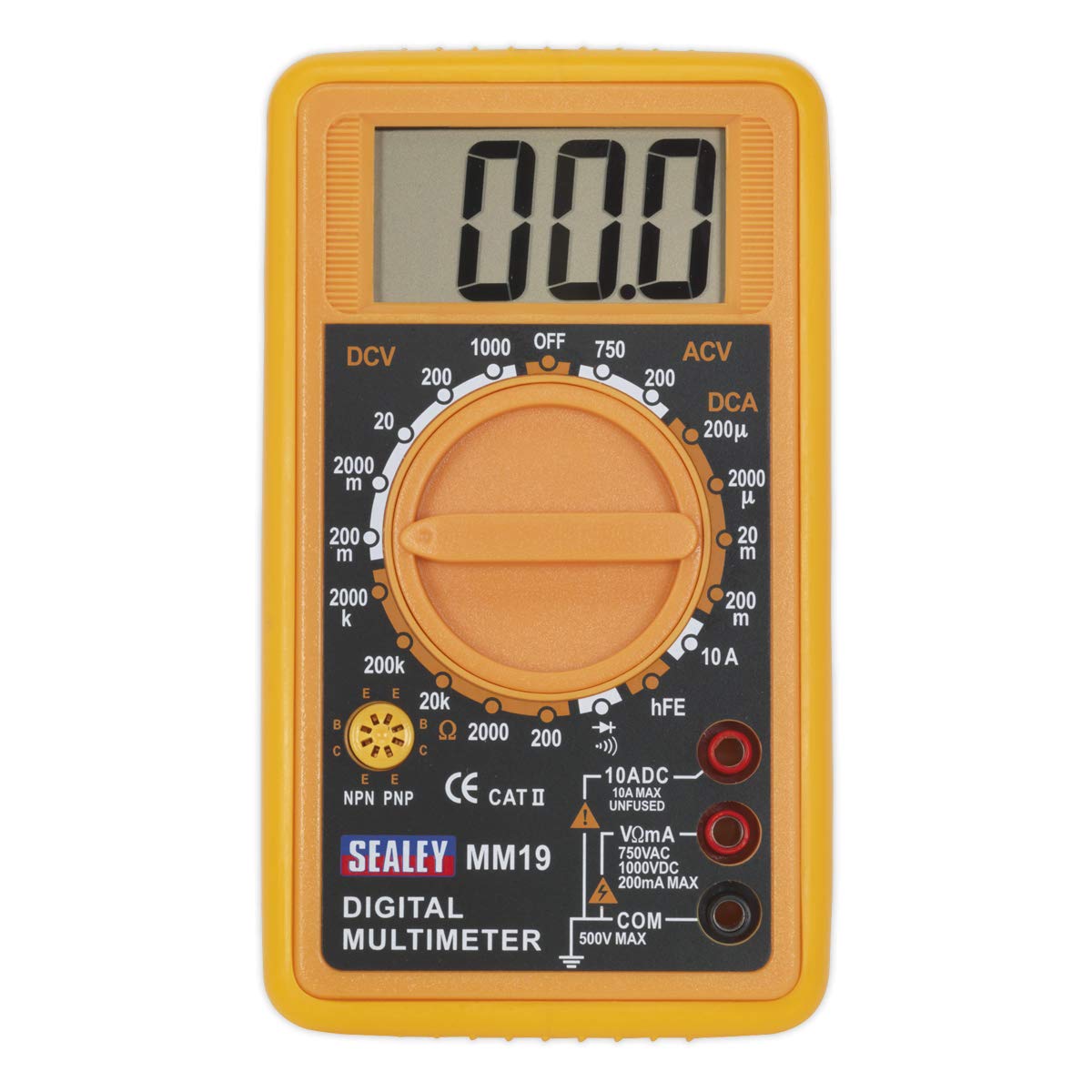
The Sealey MM19 Digital Multimeter, shown with its yellow casing, large LCD display, rotary function switch, and red and black test leads connected to the input jacks.
Zigawo:
- Chiwonetsero cha LCD: Large (46 x 25mm) digital display for reading measurements.
- Kusintha kwa Rotary: Amagwiritsidwa ntchito posankha ntchito yoyezera yomwe mukufuna komanso mtundu wake.
- VΩmA Input Jack: Za voltage, resistance, and current measurements up to 200mA.
- 10ADC Input Jack: For high current measurements up to 10A DC (unfused).
- COM Input Jack: Kuyika kofala (koipa) pamiyezo yonse.
- Soketi ya hFE: For transistor (NPN/PNP) testing.
- Mayeso Otsogolera: Red (positive) and Black (negative) leads for connecting to circuits.
4. Kukhazikitsa
4.1. Kuyika kwa Battery
The Sealey MM19 Multimeter requires a 9V battery for operation. If the display does not illuminate or shows a low battery indicator, the battery needs to be installed or replaced.
- Onetsetsani kuti multimeter yazimitsa.
- Pezani chivundikiro cha chipinda cha batri kumbuyo kwa yuniti.
- Chotsani zomangira zomwe zimateteza chivundikirocho ndikuchichotsa mosamala.
- Connect a new 9V battery to the battery clips, observing correct polarity.
- Place the battery inside the compartment and replace the cover, securing it with the screw(s).
4.2. Ma Lead Oyesera Olumikizana
The multimeter is supplied with a pair of test leads (red and black).
- Ikani the black test lead ku COM (Common) input jack.
- Pa miyeso yambiri (voltage, resistance, low current), insert the chitsanzo chofiira cha mayeso ku VΩmA jack input.
- For high DC current measurements (up to 10A), insert the chitsanzo chofiira cha mayeso ku Mtengo wa 10ADC jack input.
5. Malangizo Ogwiritsira Ntchito
To operate the multimeter, select the desired function and range using the rotary switch.
5.1. Kuyeza DC Voltagndi (DCV)
- Insert the red lead into the VΩmA jack and the black lead into the COM jack.
- Set the rotary switch to the desired DCV range (e.g., 200m, 2000m, 20, 200, 1000). Start with the highest range if the voltage sizikudziwika.
- Lumikizani ma lead oyesera kudutsa gawo kapena dera lomwe liyenera kuyezedwa.
- Werengani voltagndi mtengo pachiwonetsero cha LCD.
5.2. Kuyeza AC Voltagndi (ACV)
- Insert the red lead into the VΩmA jack and the black lead into the COM jack.
- Set the rotary switch to the desired ACV range (e.g., 200, 750). Start with the highest range if the voltage sizikudziwika.
- Lumikizani ma lead oyesera kudutsa gawo kapena dera lomwe liyenera kuyezedwa.
- Werengani voltagndi mtengo pachiwonetsero cha LCD.
5.3. Measuring DC Current (DCA)
- For currents up to 200mA: Insert the red lead into the VΩmA jack and the black lead into the COM jack.
- For currents up to 10A: Insert the red lead into the 10ADC jack and the black lead into the COM jack.
- Set the rotary switch to the desired DCA range (e.g., 200μ, 2000μ, 20m, 200m, 10A). Start with the highest range if the current is unknown.
- Zimitsani mphamvu kudera. Open the circuit where the current is to be measured.
- Lumikizani multimeter motsatizana ndi dera.
- Apply power to the circuit and read the current value on the LCD display.
5.4. Kukana Kuyeza (Ω)
- Insert the red lead into the VΩmA jack and the black lead into the COM jack.
- Set the rotary switch to the desired Resistance (Ω) range (e.g., 200, 2000, 20k, 200k, 2000k).
- Ensure the circuit under test is de-energized.
- Gwirizanitsani zoyeserera pagawo lililonse kuti muyese.
- Werengani mtengo wotsutsa pachiwonetsero cha LCD.
5.5. Mayeso Opitilira Omveka
- Insert the red lead into the VΩmA jack and the black lead into the COM jack.
- Set the rotary switch to the continuity symbol (speaker icon).
- Ensure the circuit under test is de-energized.
- Connect the test leads across the component or wire.
- If continuity exists (low resistance), the meter will emit an audible tone. The display will show the resistance value.
5.6. Diode/Transistor Verification Mode (hFE)
- Insert the red lead into the VΩmA jack and the black lead into the COM jack for diode testing.
- Set the rotary switch to the diode symbol.
- Lumikizani chingwe chofiira ku anode ndi chingwe chakuda ku cathode ya diode. Chiwonetserocho chidzawonetsa vol yamtsogolotage drop. Reverse the leads; the display should show 'OL' (open loop) for a good diode.
- For transistor hFE measurement, insert the transistor leads (Emitter, Base, Collector) into the appropriate sockets (E, B, C) in the hFE test socket, ensuring correct NPN or PNP type selection.
- Read the hFE value on the LCD display.
6. Kusamalira
6.1. Kuyeretsa
Wipe the meter casing ndi adamp cloth and a mild detergent. Do not use abrasives or solvents. Ensure the meter is completely dry before use.
6.2. Kusintha Battery
Refer to Section 4.1 for battery installation instructions. Replace the 9V battery when the low battery indicator appears on the display to maintain measurement accuracy.
7. Mavuto
- Palibe Chiwonetsero: Check battery installation and ensure the battery has sufficient charge.
- 'OL' or '1' on Display: This usually indicates an over-range condition or an open circuit. Select a higher range or check connections.
- Zolakwika: Ensure the correct function and range are selected. Check test lead connections and battery condition.
- No Continuity Tone: Verify the circuit is de-energized and the leads are making good contact.
8. Zofotokozera
| Parameter | Mtengo |
|---|---|
| Mtundu | Sealey |
| Nambala ya Model | Mtengo wa MM19 |
| Gwero la Mphamvu | Mphamvu ya Battery (9V) |
| Onetsani | Digital LCD (46 x 25mm) |
| DC Voltagndi (DCV) | 200mV, 2000mV, 20V, 200V, 1000V |
| AC Voltagndi (ACV) | 200V, 750V |
| DC Current (DCA) | 200µA, 2000µA, 20mA, 200mA, 10A |
| Kukaniza (Ω) | 200Ω, 2000Ω, 20kΩ, 200kΩ, 2000kΩ |
| Kupitiliza | Audible tone below approx. 30Ω |
| Mayeso a Diode | Patsogolo voltage drop display |
| Mayeso a Transistor | hFE (NPN/PNP) |
| Mayeso a Chitetezo | CE CAT II, IEC 1010 |
| Makulidwe (L x W x H) | 1.93 x 4.21 x 6.06 mainchesi |
| Kulemera kwa chinthu | 9.5 ounces (0.27 Kilogram) |
9. Chitsimikizo ndi Thandizo
For warranty information or technical support, please refer to the documentation provided with your purchase or contact Sealey customer service directly. Keep your proof of purchase for any warranty claims.


